

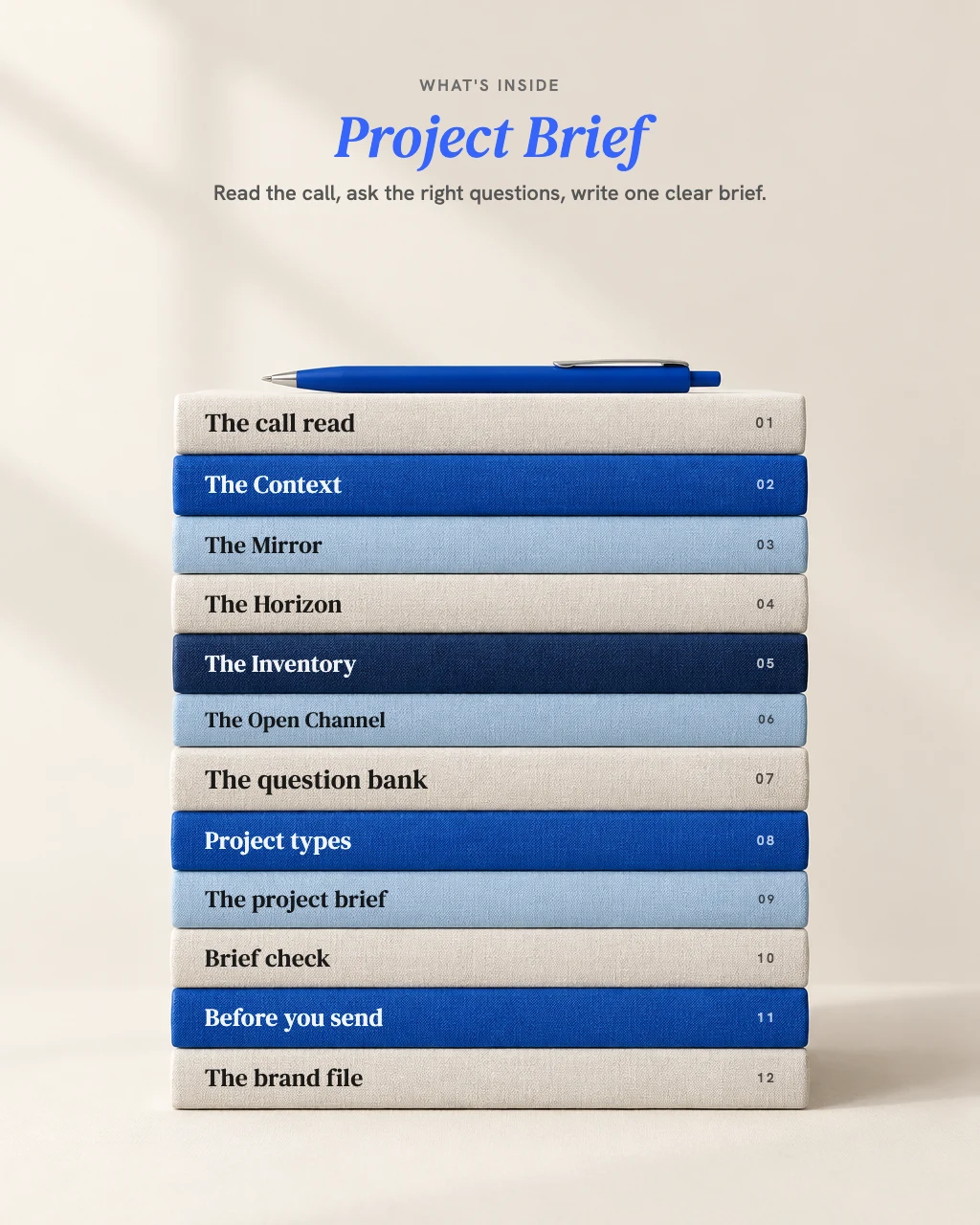
Project Brief
Ask AI for a client questionnaire and you get a generic intake form: questions the call already answered, a few that set your client homework, and nothing about what this client actually said. Project Brief installs Brand Professor's briefing method in the AI you already use: it reads your call notes for the problem the client stated and the one underneath it, finds the one tension that matters most, writes a Pre-Brief for this client, and turns the answers into a clear, single-minded brief.
Not a generic intake form. Questions written for this client, from what they said on the call.
- Reads your call for the stated problem and the real one, and finds the one tension that matters most
- Never asks again what the call answered, never sets homework, never invents a fact
- Write a Pre-Brief, write the project brief, or check a brief you were sent
One payment, no subscription.
Your AI reads your discovery call for the real problem, writes the questionnaire your client fills in before kickoff, and turns the answers into a brief your team can start from.
- Reads your call for the stated problem and the real one, and finds the one tension that matters most
- Never asks again what the call answered, never sets homework, never invents a fact
- Write a Pre-Brief, write the project brief, or check a brief you were sent
- One payment, no subscription
- Download straight after paying, and a copy in your inbox
- Free updates within this version
Payment is handled by Stripe. We never see your card number.
Secure payment by Stripe. Card, Apple Pay or Google Pay. Download straight after.
Every skill on the site in one payment. Seven of them share one brand file, so you explain your business once.
- Brand Strategy
- Brand Naming
- Copywriting
- Content Hooks
- Page Planner
- Proposal Builder
- Project Brief
- UI Guidelines
- You save $213.00 on buying them separately
- One payment, no subscription
- All 8 downloads straight after paying, and a copy in your inbox
- Free updates within each version
Payment is handled by Stripe. We never see your card number.
Need all 8? Get the full set, $249.00 $462.00Black Friday, until 30 November
- Works in Claude, ChatGPT and other AI tools that read skills
- One payment, no subscription
AI can write a client questionnaire. It can't tell you what to ask.
Most projects that go wrong were wrong at the brief. The client said what they wanted; nobody found out what they needed; the team filled the gaps with guesses. Plain AI will happily write you an intake form: the same questions for a joinery as for a law firm, some of them already answered on the call, and a few that hand your client homework. The hard part is reading the call for the problem underneath the one they stated, and asking the questions that get the real material out.
Written for this client.
It reads your call notes first, quotes them back, and asks one level deeper instead of asking again.
One tension, asked early.
It finds the question that matters most and puts it near the top, flagged.
Open the last brief you worked from. Find the one sentence that says what the work must land. If you can't find it, or you find three, that's the gap.
Which one is you?
Agencies and studios who run discovery calls.
A questionnaire your client fills in before kickoff, and a brief your team can start from.
Freelancers, consultants and coaches.
Brand, website, packaging, campaign, content, product, naming or coaching work, for a business or a person.
In-house teams who brief agencies.
A brief with one job, every fact sourced and every gap marked.
Not for you if you want a generic intake form.
Any form builder has one.
Same brief, two answers. A test run, 20 November 2026.
The brief: Priya runs a two-person web studio and wants a pre-brief for Marco Bellini of Bellini Joinery, a family business in Bristol making fitted kitchens and wardrobes since 1987, nine staff. From the call: the site "looks like 2009", "nobody calls us from it", work comes from word of mouth and the showroom, his daughter Sofia's Instagram "does all right", a rival is "all over Google", and, twice, "we're not cheap and we shouldn't pretend to be." Launch before the spring home show in March. No budget discussed. Sofia, who "will have opinions", wasn't on the call.
The real problem.
Both read past "a new website". The plain AI said the site's job is "probably to back up that trust" for people already recommended. Project Brief went further, in a private read for Priya labelled as a guess: the site has never had a defined job in how Bellini wins work, and nothing says what a customer gets for the extra money.
The main tension.
The plain AI noticed winning new people was "worth deciding on purpose", then answered it for Marco: a premium site "will also bring you better-fit enquiries". Project Brief named it, more enquiries or the right ones, and made it question 2, a forced choice flagged as the single most important answer.
What the call already answered.
Neither asked it again. The plain AI played the call back for Marco to correct. Project Brief quoted it back inside deeper questions: "You said twice, 'we're not cheap and we shouldn't pretend to be.' What does a customer actually get for the extra money?"
Homework.
Neither set any. No mission statement, no tagline, in either.
Invented facts.
Neither invented a fact about Bellini. The plain AI stated two opinions as fact: that professional photography "often makes the biggest single difference", and that a premium site will bring better-fit enquiries. Project Brief left the show's name and date and the return date blank for Priya to fill, rather than guess.
Private notes.
The plain AI wrote one document, to Marco, with its own reading of his positioning inside it. Project Brief kept its call read and question map in sections headed "for you only, never sent to Marco".
Questions asked.
Money questions.
The plain AI said "Even a range helps" for budget, with no word on who reads it. Project Brief put a privacy line on budget, past spend, customers, Sofia's role and a proud job, and offered a range.
Sofia.
The plain AI did this well: it asked for Sofia in the next conversation, because it is "much easier to hear her views early than late". Project Brief asked whether she decides or advises, in neutral words, invited her to answer the Instagram question herself, and added a "Bring her in now" check before sending.
Next steps.
The plain AI ended with a route to a proposal: budget, a call with Sofia, scope and price. Project Brief's Pre-Brief stops at the questions; the brief comes from the answers.
A test run, not a customer.
The studio and the client are fictional and the call notes were scripted. The plain AI was a general AI assistant with no skill, given the same brief in one message.
The questions it asked in this week's test run
"When the right person lands on the new site, which matters more?"
Pre-Brief test run: a joinery's website
"You said twice, 'we're not cheap and we shouldn't pretend to be.' What does a customer actually get for the extra money?"
Pre-Brief test run: a joinery's website
"If a customer picked Hartwell over you, what's the most honest case they'd make?"
Pre-Brief test run: a joinery's website
"The work keeps coming, and the site has looked like this for a while. What is the real reason it hasn't been changed until now?"
Pre-Brief test run: a joinery's website
You can, and you'll get a tidy one. What you won't get is the work around the questions: a private read of the call, the stated problem and the real one, the one tension worth the most attention, and a map of what each answer is for. Project Brief runs inside ChatGPT or Claude. It's the same AI, given a method: read the call first, never ask again what it answered, never set your client homework, and never invent a fact about them.
What you get: the questions, and the brief they build
1. A private read of the call.
The stated problem in your client's words, a labelled guess at the real one, the gaps, and the one tension that matters most.
2. The Pre-Brief.
About 45 minutes of questions in five parts, written for this client, ready to send.
3. The question map.
What each answer is for and what to listen for. For you only.
4. The project brief.
Sixteen sections, one job, every fact sourced and every gap marked, for whoever does the work.
Plus, in the download.
A quickstart and install guide, and three sample outputs from the test runs: a Pre-Brief, a brief from the answers and a check of a weak brief. Free updates for every version 1 release.
Three ways in
Tell your AI what you need. It reads what you paste first, and asks only what that leaves open.
Pre-Brief.
Paste your call notes. You approve a private read of the call, then get the questionnaire your client fills in before kickoff, and a map of what each answer is for.
Project Brief.
From the call, the client's answers and any documents: one to three pages someone new could start work from, with every open question listed.
Brief Check.
Paste a brief you were sent. You get a verdict, the three problems that will cost the most, the questions to send back, and a rewrite with every gap marked if you want one.
Already have a brand file?
If you've used another Brand Professor product, it starts from your brand file, so nothing is asked twice.
How it works
It stops at each step until you approve or correct it.
Paste the call.
Notes, a transcript or an email thread. It reads them before it asks anything.
- Your checkpoint
Approve the call read.
Is the real problem right? Is the main tension the right one? Correct it, then approve.
Send the Pre-Brief.
Add your return date and send it. The question map stays with you.
Brief from the answers.
Paste what comes back. It checks the answers against the call read, then writes the brief.
What it will not do
Invent anything about your client.
Their numbers, rivals, history or words. If the call didn't say it, it asks.
Invent targets, dates or budgets.
It uses yours or marks the gap.
Set your client homework.
No "write your mission statement" in a questionnaire.
Show your client your private notes.
The call read and the question map stay with you.
Pass off a guess as a fact.
Its reading of the real problem is labelled as a guess, for you to check.
Answers to your questions
Will my client see the diagnosis?
No. The call read and the question map come marked for you only. Only the Pre-Brief goes to the client.
Which projects does it cover?
Brand, website, packaging and labels, campaign and launch, content and social, product and app, naming, consulting and coaching, for a business or a person, and anything else through a general method.
What if my call notes are thin?
Thin notes give a thinner Pre-Brief. The more the notes say in the client's own words, the better the questions.
Which AI tools does it work in?
Claude, Claude Code, ChatGPT where your plan supports skills, and other AI tools that read skills. The install guide covers each one.
Can I send it straight to my client?
Check it first. It drafts; you read it before it goes out, and add your return date.
The expert behind this method

Sahil Gandhi, Brand Professor.
300+ brands and 100+ AI systems built. The pre-brief method is his, used before his own client work and widened here from brand workshops to any project: read for the real problem, find the one tension, quote the client back, and collect material instead of setting homework.
Verify: brand-professor.com
What this job costs to have done.
Published market rates, stated as ranges. A person brings their own judgment; Project Brief brings a working method to the AI you already use, for one payment.
Ranges as published by each source, checked 20 and 21 November 2026. Prices vary by market, scope and experience.
Your client knows things the project needs. The Pre-Brief is how you hear them before kickoff, not after.
Secure payment by Stripe. Card, Apple Pay or Google Pay. Download straight after.
Every skill on the site in one payment. Seven of them share one brand file, so you explain your business once.
- Brand Strategy
- Brand Naming
- Copywriting
- Content Hooks
- Page Planner
- Proposal Builder
- Project Brief
- UI Guidelines
- You save $213.00 on buying them separately
- One payment, no subscription
- All 8 downloads straight after paying, and a copy in your inbox
- Free updates within each version
Payment is handled by Stripe. We never see your card number.
Need all 8? Get the full set, $249.00 $462.00Black Friday, until 30 November
Related skills
Your AI asks before it writes, picks one angle, writes in your voice and never makes up a quote, a number or an offer.
Your AI writes 50 or more openings from your own stories and numbers before it judges one, names what each one promises, and never makes up a result.
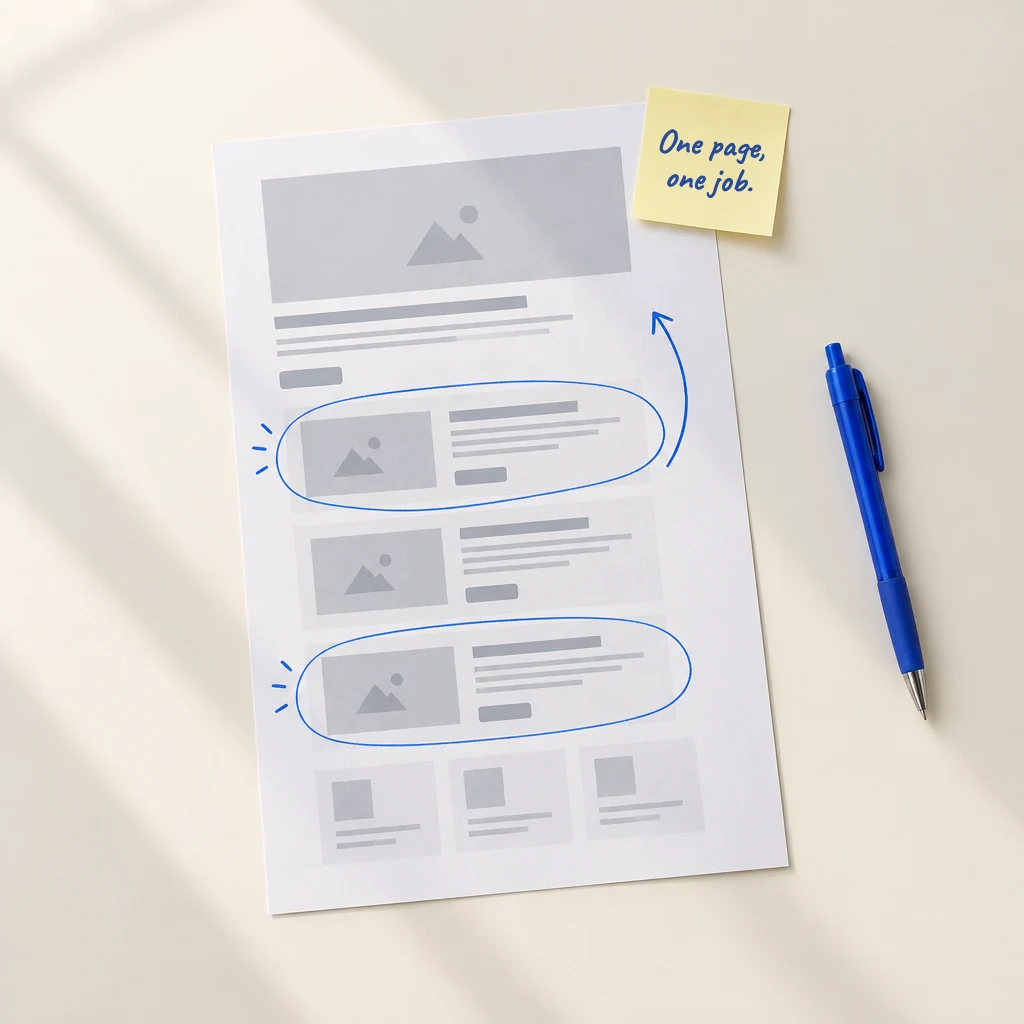
Your AI agrees who the page is for and what it promises, gives every section one job, and hands you a grey, annotated wireframe with every missing fact marked, never made up.