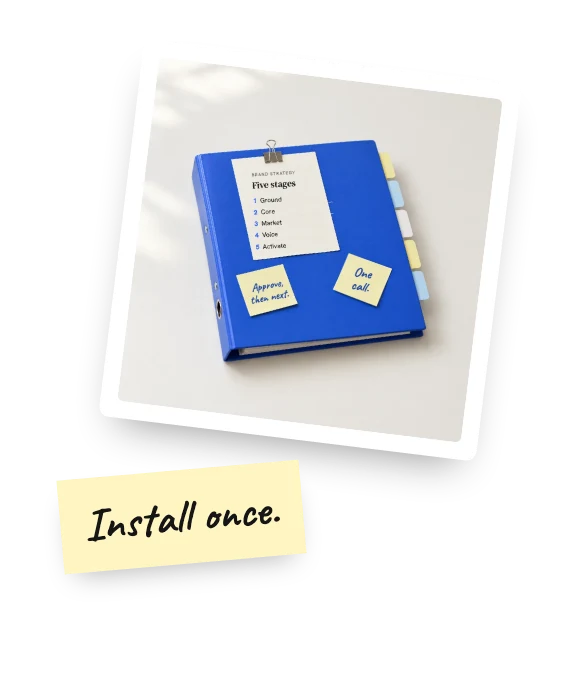
Know what to say? This writes it.

Copywriting, by Brand Professor

Ask AI for copy and it writes something that could belong to anyone, with a testimonial slot waiting for a quote nobody said. Copywriting installs Brand Professor's working method in the AI you already use, so it works the way a senior copywriter works: it asks first, finds your reader's own words, picks one angle, writes in your voice, and never makes up proof.

Not a writing prompt. A brief, your voice, and copy where every claim is backed or marked.

  • Writes nothing until you approve the brief
  • Never invents a quote, a number or an offer: every gap is marked
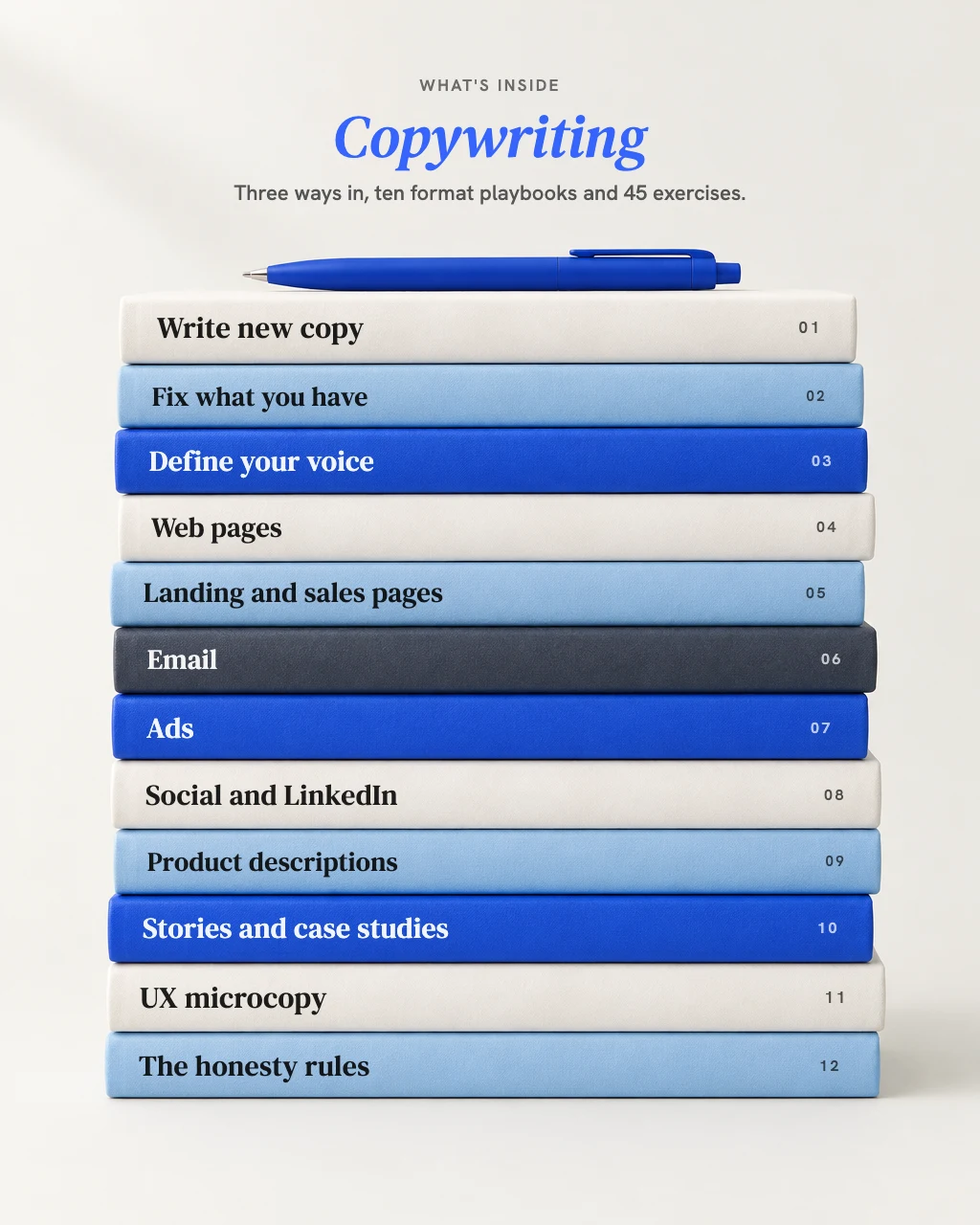
  • Write new copy, fix what you have, or define your voice
$69.00$120.00Launch price, first 100 buyers
Launch price for the first 100 buyers. One payment, no subscription.
Buy now

Secure payment by Stripe. Card, Apple Pay or Google Pay. Download straight after.

See the deliverable first Browse more skills
  • Works in Claude, ChatGPT and other AI tools that read skills
  • One payment, no subscription
  • Read a full sample run before you buy
Expert:
Sahil Gandhi, Brand Professor
Files:
18 (the skill, quickstart, install guide, workbook, 3 templates, 3 sample outputs, license, terms, changelog, support)
Works with:
Claude, Claude Code, ChatGPT and other AI tools that read skills
Instant download Free updates

AI can write anything. That is the problem.

Plain AI copy looks finished. A headline, three benefits, a testimonial block, a button. Then you read it closely. The refund policy it wrote is one you never offered. The quotes are placeholders. Every line would work just as well for your competitor. The writing was never the hard part. The hard part is knowing what this reader needs to believe, what you can actually prove, and how you sound when you are being yourself.

The brief before the draft.

It writes down the real job, the reader and the one action, and waits for your approval.

Your voice, not the category's.

Built from your own writing, or from three words you give it, then every piece is checked against it.
Try this now

Cover your logo and read your homepage. If you can't tell it's yours, neither can your reader.

Three ways in

Tell your AI what you need. It asks up to three short questions and picks the route.

Write something new.

A brief first, a working draft with the argument laid out, then the final copy with what is still missing marked. Quick jobs, like a button, an error message or a subject line, get five options and a recommendation in one step.

Fix what you have.

Paste the copy. It tells you what works, what fails and the one change that matters most, before it rewrites a word.

Define your voice.

From three or more things you have written, or from a short interview. Every trait is backed by your own words, and saved so every future piece sounds like you.

Already have a brand file?

If you have run Brand Strategy or Brand Naming, it starts from your brand file instead of asking again.

The questions it asked in this week's test runs

"In one sentence, what does this do that a close competitor does not, and for whom?"

Landing page test run

"What can we back up? Customer words, beta results, numbers, reviews, press."

Landing page test run

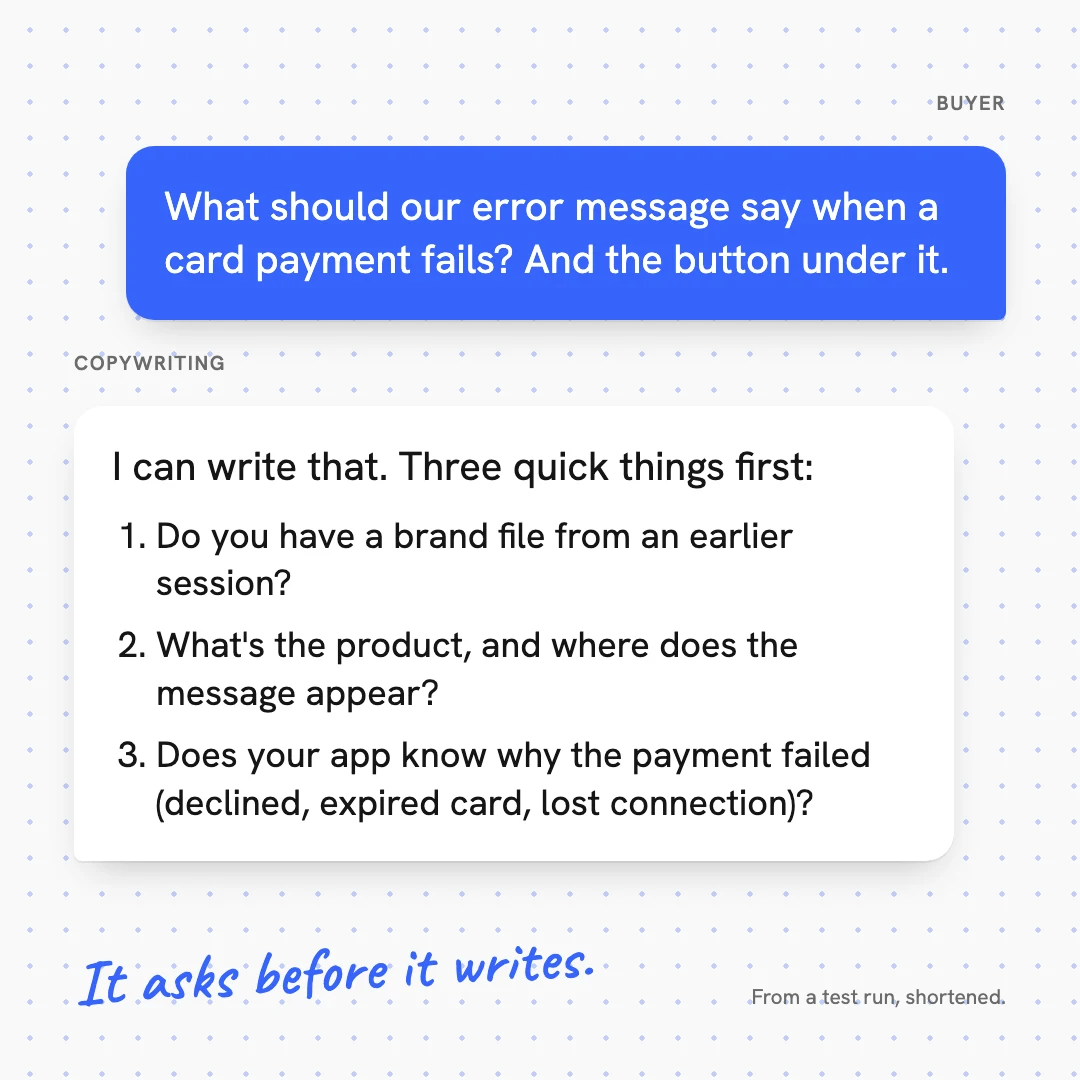
"Does your app know why the payment failed (declined, expired card, lost connection), and is there a space limit or a tone you want?"

Quick test run: a payment error message

"What do the first lines of the email tell the shopper: the new delivery time, the reason, anything you're offering?"

Quick test run: a subject line

"Does it go out before the original delivery slot, or after it's been missed?"

Quick test run: a subject line

Same brief, two answers. A test run, 3 November 2026.

The brief: Tidewell, a sleep-tracking ring for shift workers: nurses, factory staff, pilots. It learns a rotating schedule and says when to nap and when to avoid caffeine. $199, plus an optional $6 a month coaching plan. The readers are exhausted and have tried apps that assume a 9-to-5. The goal is pre-orders. Tone: calm, not techy. No proof yet: 40 beta users, no quotes collected.

The moment that matters.

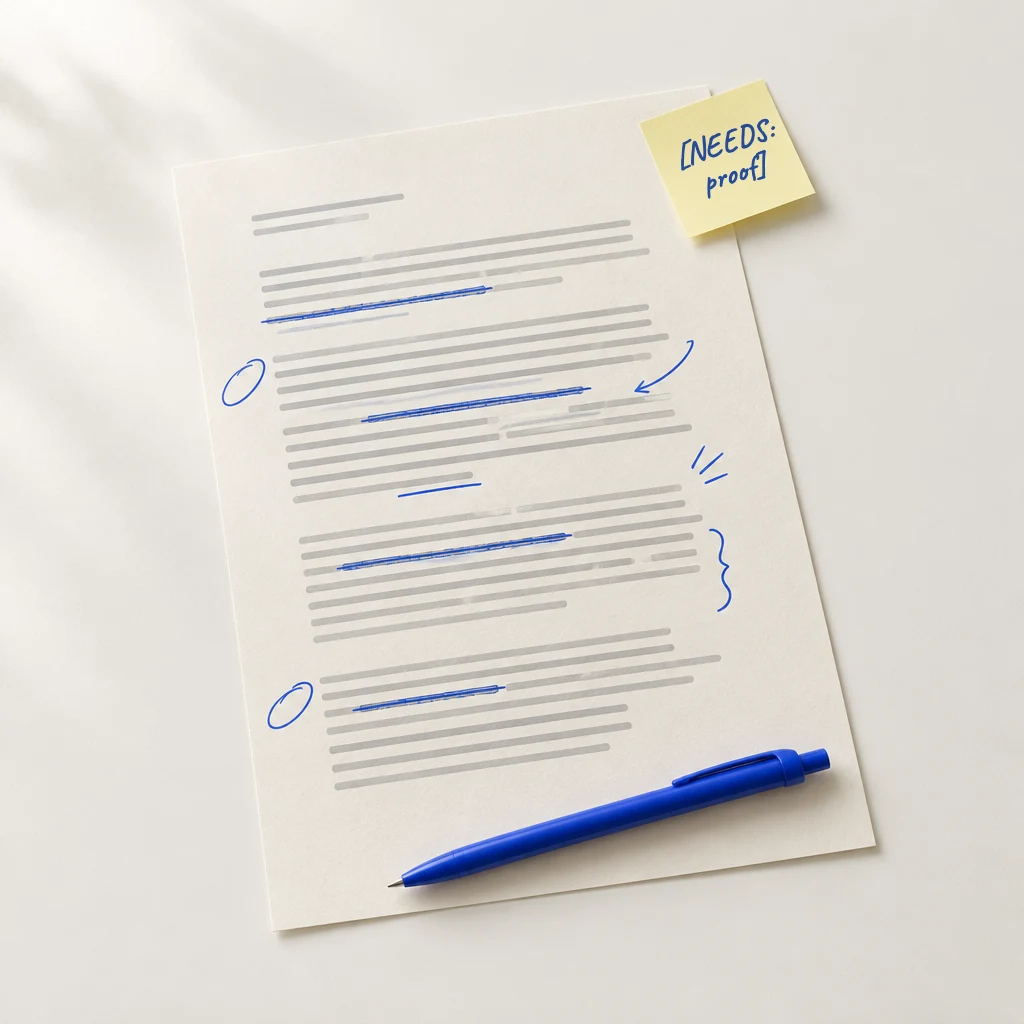
The plain AI's page promised a full refund on any pre-order before shipping and a free sizing kit. The founder offered neither. Published as written, those are promises the business now has to keep. Copywriting asked, then left the refund answer as a gap for the founder to fill: "[NEEDS: your pre-order refund or return terms, from you]".

Questions asked.

Plain AInone.
Copywriting7, in one message, then a brief to approve before any copy.

The headline.

Plain AI"Sleep that works around your shifts, not someone else's."
Copywriting"Know when to nap before a night shift."

Rivals read.

Plain AInone.
Copywritinga shift-work sleep app's own page, which already promised advice on sleep and caffeine timing. So it rewrote a line that would have said every app ignores shift workers.

Testimonials.

Plain AIthree placeholder quotes ready to fill, like "[Quote from a beta tester, e.g., a night-shift nurse]".
Copywritingnone. A message to send the 40 beta users, asking what they used and whether they can be quoted.

Other invented details.

Plain AIa ring you can wear "under gloves", and free coaching months as an early-bird offer.
Copywritingnone. It cut its own line about "the first thing you'll notice", because that was a guess.

Testing.

Plain AI"Try A/B testing" the headline.
Copywritinga reader test for three to six shift workers, with the exact tasks and what to bring back.

Fixing a homepage, the same day.

Both found the real problem: Northpaw only works with independent pet brands, and the page never said so. The plain AI rewrote it straight away in three tones and offered a "free 30-minute chat" the agency never mentioned. Copywriting reviewed first and rewrote only after approval, keeping the founder's own count, "about a dozen pet brands".

A test run, not a customer.

The businesses are fictional and the founders' answers were scripted. The full Northpaw output is linked from "See the deliverable first" by the price.

What they wrote back

“We rewrote our landing page with the copywriting skill. Qualified demo requests went from 11 to 26 a month in eight weeks.”
Founder, Accounting Software Company
“I’m a physiotherapist, not a marketer. I worried I’d need to know the jargon, but it asked plain questions and did the expert part.”
Physiotherapist & Clinic Owner
“I didn’t believe paying for a skill could beat free AI. The free worked example changed my mind, and the real thing was better.”
Owner, D2C Grooming Brand

From people who have used Sahil Gandhi's skills, frameworks and processes in their own work. Names withheld at their request. Results vary from business to business.
What changes when it's installed

It asks before it writes.

No copy until the brief is agreed.

It writes in your voice, not the category's.

Every headline, subhead and button is tested by putting a rival's name on it.

It shows its argument.

You see what the piece opens on, turns on, proves and closes on, before the polish.

It never invents proof.

No made-up quotes, numbers, offers or policies. Gaps are marked with who can fill them.

It tells you how to test it.

A short test with real readers, with the exact questions, instead of a guess.
From a Copywriting test run: the buyer asks for an error message, and it asks three questions first

How it works

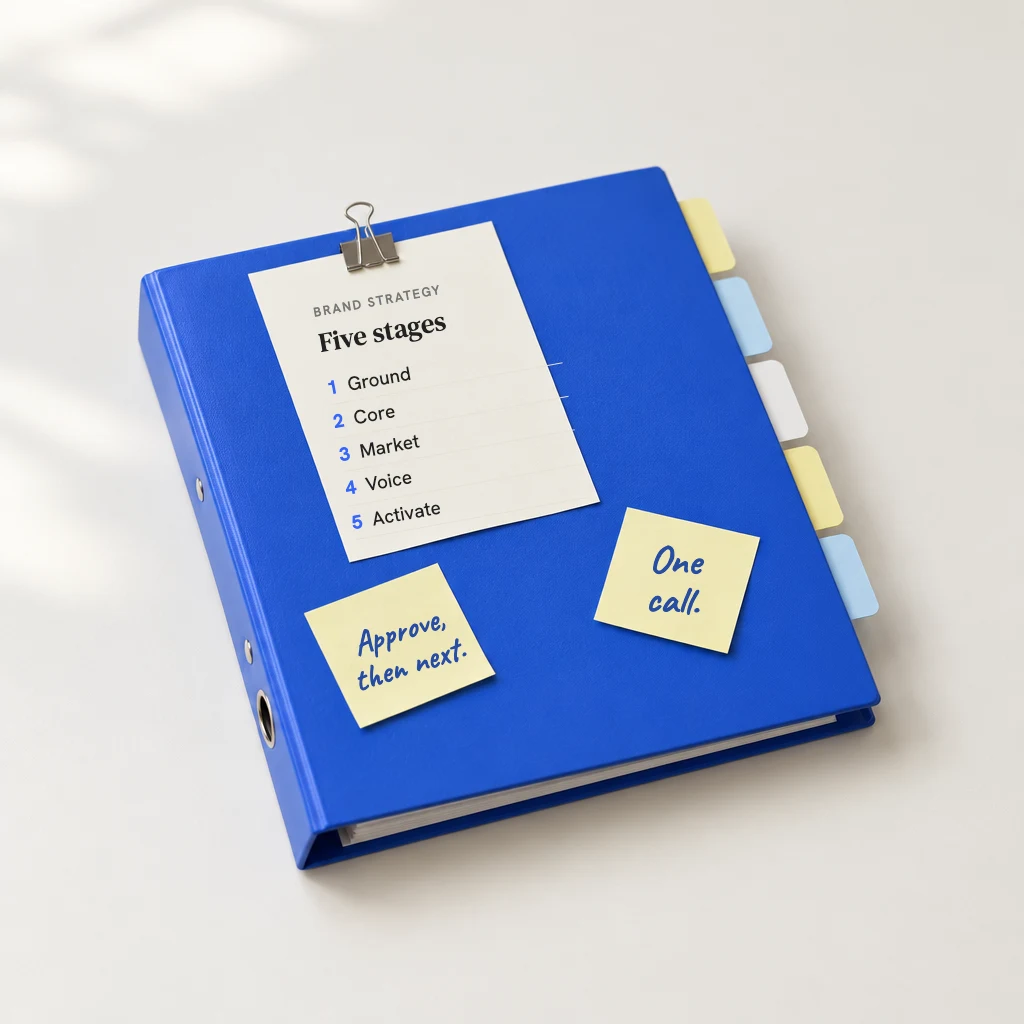
It stops at each step until you approve or correct it.

1. Say what you need.

A page, an email, an ad, a post, a button. Up to two rounds of questions, sent together.

2. Approve the brief.

The real job, the reader, the one action, what is known and what is missing. No sample lines.

3. Approve the rough draft.

The whole piece and its argument, while it is still cheap to change.

4. Take the final copy.

With every gap marked and a reader test to run.

What you get: the copy, and what to do with it

1. The copy, ready to paste.

Clean, first, with slot names and character counts if it goes to a designer.

2. The call and why.

The one choice the copy makes, and the reasons.

3. Every gap, marked.

Anything it couldn't back is flagged at the exact spot, with who can fill it.

4. A reader test.

What to show, to whom, the exact questions and what to bring back.

Plus, in the download.

A quickstart and install guides, a copy brief template, a voice profile template, a final copy template, a workbook to fill in before your first session, and three sample outputs from the test runs. Free updates for every version 1 release.

Who it is for, and who it is not for

Founders who write their own copy.

It asks the questions an agency would, and writes in your voice.

Marketers who need copy that sounds like the brand, not like AI.

The voice is set once and every piece is checked against it.

Consultants and agencies who write for clients.

Each client gets their own voice profile and brand file.

Not for you if you want 50 blog posts by Friday.

Plain AI does that already.

What it will not do

Invent proof.

No made-up testimonials, numbers, results, client names, ratings, awards, deadlines or scarcity.

Pretend to test with real readers.

It writes the test and waits for what people said.

Write before the brief is approved.

Not even a sample headline.

Write "in the style of" a real person.

It captures the quality you admire, in your brand's own terms.

Promise results or check legal compliance.

You check the claims before you publish.

The expert behind this method

Sahil Gandhi, Brand Professor.

300+ brands and 100+ AI systems built. This skill is how he writes copy: the brief before a word is written, the reader's own words before the angle, and every gap marked instead of filled.

Answers to your questions

Can't I just prompt this myself?

You can prompt for words. You can't prompt for the questions you didn't know to ask. See the side-by-side above.

Will everyone who buys it sound the same?

No. The method is shared; the voice is yours, built from your own writing.

Is the copy ready to publish?

It's ready to check. You're responsible for every claim you publish, and anything it couldn't verify is marked.

Should I run Brand Strategy first?

If you haven't decided what the brand should say, yes. If the copy job turns out to be a positioning or naming job, it tells you and offers Brand Strategy or Brand Naming once.

Which AI tools does it work in?

Claude, Claude Code, ChatGPT and other AI tools that read skills. The install guide covers each one.

Does it put its method names in my copy?

No. Those names are for its own planning. Its rules require plain words in everything it hands you.

A reader decides in the first line. Make it one only you could write.

$69.00$120.00 Buy now

Secure payment by Stripe. Card, Apple Pay or Google Pay. Download straight after.