

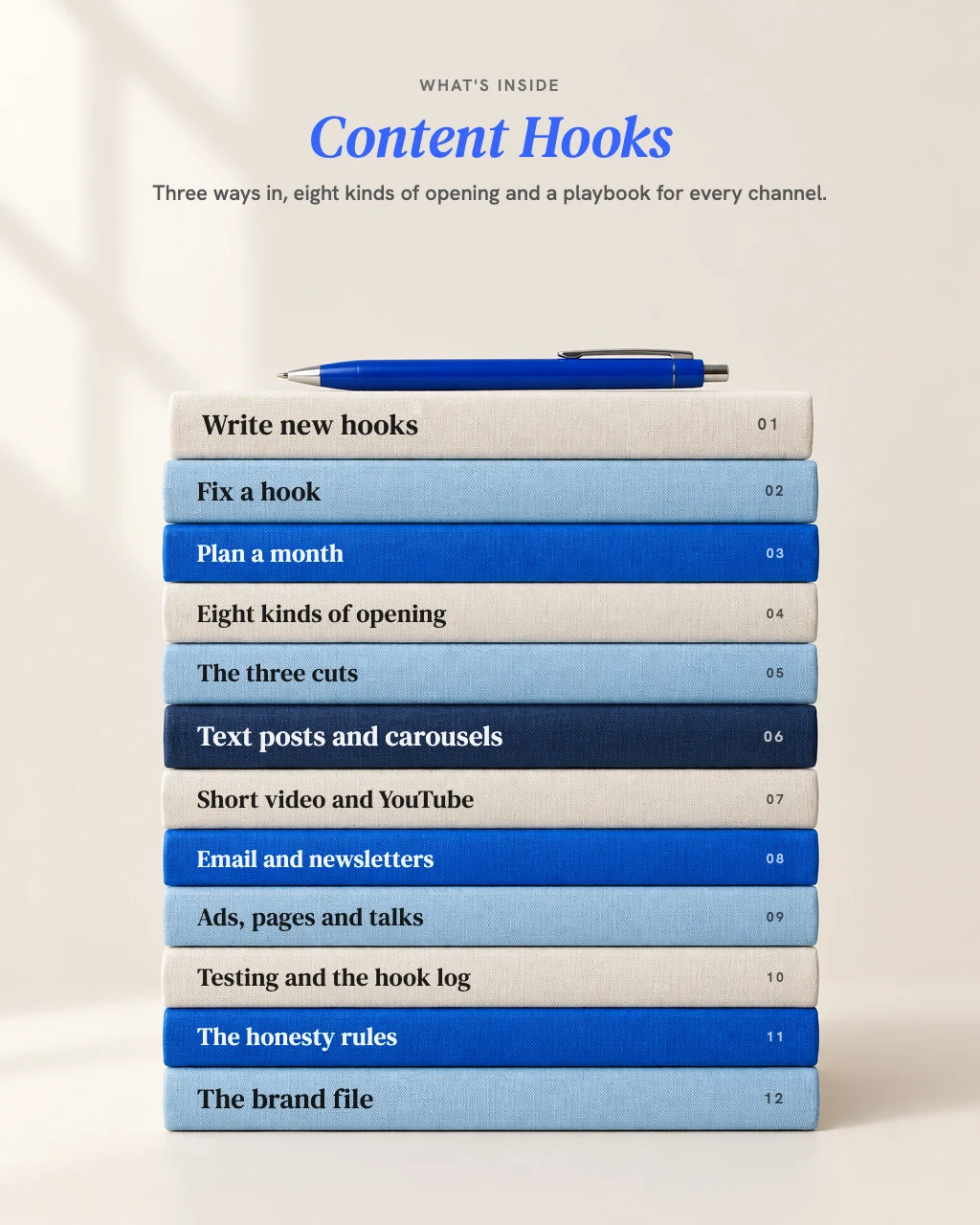
Content Hooks
Ask AI for a hook and you get the ones everyone gets: "Unpopular opinion", "Nobody talks about this", a question nobody asked and a number nobody can check. Content Hooks installs a working method for opening lines in the AI you already use: it finds out who is scrolling and what they were doing a second before, collects the true material only you have, writes 50 to 100 openings of different kinds before judging one, and tells you what each line promises.
Not a list of viral templates. Openings built from what's true about you, each with the promise it makes.
- Writes 50 to 100 openings, of at least five kinds, before it judges one
- Built from your own stories, mistakes and numbers; never a made-up result
- Write new hooks, fix one that stopped working, or plan a month
One payment, no subscription.
Your AI writes 50 or more openings from your own stories and numbers before it judges one, names what each one promises, and never makes up a result.
- Writes 50 to 100 openings, of at least five kinds, before it judges one
- Built from your own stories, mistakes and numbers; never a made-up result
- Write new hooks, fix one that stopped working, or plan a month
- One payment, no subscription
- Download straight after paying, and a copy in your inbox
- Free updates within this version
Payment is handled by Stripe. We never see your card number.
Secure payment by Stripe. Card, Apple Pay or Google Pay. Download straight after.
Every skill on the site in one payment. Seven of them share one brand file, so you explain your business once.
- Brand Strategy
- Brand Naming
- Copywriting
- Content Hooks
- Page Planner
- Proposal Builder
- Project Brief
- UI Guidelines
- You save $213.00 on buying them separately
- One payment, no subscription
- All 8 downloads straight after paying, and a copy in your inbox
- Free updates within each version
Payment is handled by Stripe. We never see your card number.
Need all 8? Get the full set, $249.00 $462.00Black Friday, until 30 November
- Works in Claude, ChatGPT and other AI tools that read skills
- One payment, no subscription
AI can write a hook. So can everyone else's.
Plain AI hooks look like hooks. A bold first line, a pause, a twist. Then you scroll your own feed and see the same shapes on every third post. The best-sounding ones often lean on something you never said: a number, a result, a client quote nobody agreed to. The writing was never the hard part. The hard part is knowing who is scrolling, what is true about you that nobody else can say, and what the rest of the post can actually pay off.
Your material, not a template.
It asks for a story, an opinion, a mistake and your customers' words, and builds the openings from those.
Every line names its promise.
So you never ship a hook the post can't keep.
Cover your name and read the first line of your last five posts. If a competitor could have posted any of them, that's the line to fix.
Which one is you?
Founders and consultants who post to win clients.
It finds the openings in work you've already done.
Creators and personal brands posting every week.
A month of hooks from one session, and a log that learns what your readers stop for.
Social media managers and marketers writing for several brands.
Each brand's material, voice and results kept in its own brand file.
Not for you if you want a list of viral templates.
Plain AI has thousands.
Same brief, two answers. A test run, 19 November 2026.
The brief: a freelance brand designer wants hooks for a LinkedIn post about the worst brief they ever received. Readers: in-house marketing managers, on their phone between meetings. The post tells the story of a brief that said "make it pop, but premium, but fun, for everyone", four lines long with a nine-day deadline, and the designer's mistake: saying yes without asking anything, then redoing the logo six times. A marketing manager once replied to their questions with "nobody's ever asked us that". No results to share.
The moment that matters.
The plain AI quoted the client's brief and the marketing manager's reply as hooks, and gave the manager a gender ("She replied") that nobody mentioned. Content Hooks held both quotes back until the designer confirmed the wording and that each person was happy to be quoted, unnamed.
Questions asked.
Openings written.
The hook.
Plain AI's pick: "The brief was four lines long. It said: 'Make it pop, but premium, but fun, for everyone.'" Content Hooks, after the designer combined two of the shortlist: "The brief was four lines long, with a nine-day deadline. I said yes without asking a single question, then redid the logo six times."
The reader.
Content Hooks flagged that marketing managers write briefs, so openings that mock the brief could read as mocking them, and cut lines that did. The plain AI kept "Marketing managers: your designer is guessing."
Forecasts.
Checked against what's live.
Testing.
A test run, not a customer.
The designer is fictional and the answers were scripted. The plain AI was a general AI assistant with no skill, given the same brief in one message.
The questions it asked in this week's test runs
"Who should stop for it? Describe one person, and where and when they'll see it."
LinkedIn post test run
"Is the post already written? If so, paste it, or tell me what it says and what it ends on."
LinkedIn post test run
"Any true material I can use: a story from the free consultations, a number you've recorded, anything a client has said to you (pasted as they said it)."
Quick test run: a newsletter subject line
"Who reads the newsletter, and when and where do they usually open it?"
Quick test run: a newsletter subject line
You can, and you'll get a dozen. Some will be good. What you won't get is the work before and after the writing: who is scrolling, what you can say that nobody else can, whether the post keeps the promise, and whether that line is already all over the feed. Content Hooks runs inside ChatGPT or Claude. It's the same AI, given a method: ask first, write fifty, cut on three tests, and never quote anyone who hasn't agreed.
What you get: the hook, and what to do with it
1. The hook, ready to paste.
With its preview text, cover or thumbnail line where those go with it.
2. Two to test against it.
A safe and a bold version, and how to compare them.
3. What it promises.
And what the next line has to do, so the post keeps it.
4. A check against what's live.
Searched before you post, so you don't ship a line the feed has seen a hundred times.
Plus, in the download.
A quickstart and install guides, a raw-material workbook, a hook brief template, a final template, a hook log, and two sample outputs from the test runs. Free updates for every version 1 release.
Three ways in
Tell your AI what you need. It asks up to three short questions and picks the route.
Write new hooks.
A brief first, then fifty or more openings, cut to a shortlist, then the final with a way to test it. One line for a piece you've already written gets five options and a recommendation in one step.
Fix a hook.
Paste it, and your numbers if you have them. It finds out why it isn't working, or why it stopped, before it rewrites a word.
Plan a month.
Turns what you have to say into a run of posts, writes the hook for every slot, and gives you a log. Bring the log back and it learns which openings your readers stop for.
Already have a brand file?
If you've run Copywriting, Brand Strategy or Brand Naming, it starts from your brand file, voice included.
How it works
It stops at each step until you approve or correct it.
Say what it opens.
A post, a video, an email, an ad. One round of questions, two at most.
- Your checkpoint
Approve the brief.
Who's scrolling, what they should do next, and the true material it will build from. No sample lines.
- Your checkpoint
Pick from the shortlist.
Five to eight openings from fifty or more, each with what it promises.
Take the final.
With a test plan, or a first-hour check for a one-off post.
What it will not do
Invent proof.
No made-up numbers, results, client names, follower counts, deadlines or scarcity.
Invent your story.
The honest-mistake and real-result openings stay closed until you give it the real thing.
Quote anyone without permission.
It asks first, and holds the line back until you confirm.
Use worn templates.
"Unpopular opinion:", "Stop scrolling" and "Read that again" are on its banned list.
Promise views.
Every hook is a best bet with a way to test it, read from your numbers, not its guesses.
Answers to your questions
Will my hooks sound like everyone else's who buys it?
No. The method is shared; the material is yours: your stories, your mistakes, your customers' words.
Does it write the whole post?
No. It writes the opening and, where useful, the next line. Copywriting writes the whole piece.
Which platforms does it cover?
LinkedIn, Instagram, TikTok and YouTube Shorts, YouTube titles, X and Threads, email subject lines, newsletters, ads, landing pages, cold email, talks and podcasts.
Which AI tools does it work in?
Claude, Claude Code, ChatGPT and other AI tools that read skills. The install guide covers each one.
Can it tell me what will go viral?
No, and nothing can. It gives you the best bet and a way to test it, then learns from the numbers you bring back.
The expert behind this method

Sahil Gandhi, Brand Professor.
300+ brands and 100+ AI systems built. This skill holds his rules for an opening line: start from what is true, write many before choosing one, and never let a hook promise what the piece can't keep.
Verify: brand-professor.com
What this job costs to have done.
Published market rates, stated as ranges. A person brings their own judgment; Content Hooks brings a working method to the AI you already use, for one payment.
Ranges as published by each source, checked 20 and 21 November 2026. Prices vary by market, scope and experience.
Your post is already worth reading. The first line decides whether anyone finds out.
Secure payment by Stripe. Card, Apple Pay or Google Pay. Download straight after.
Every skill on the site in one payment. Seven of them share one brand file, so you explain your business once.
- Brand Strategy
- Brand Naming
- Copywriting
- Content Hooks
- Page Planner
- Proposal Builder
- Project Brief
- UI Guidelines
- You save $213.00 on buying them separately
- One payment, no subscription
- All 8 downloads straight after paying, and a copy in your inbox
- Free updates within each version
Payment is handled by Stripe. We never see your card number.
Need all 8? Get the full set, $249.00 $462.00Black Friday, until 30 November
Related skills
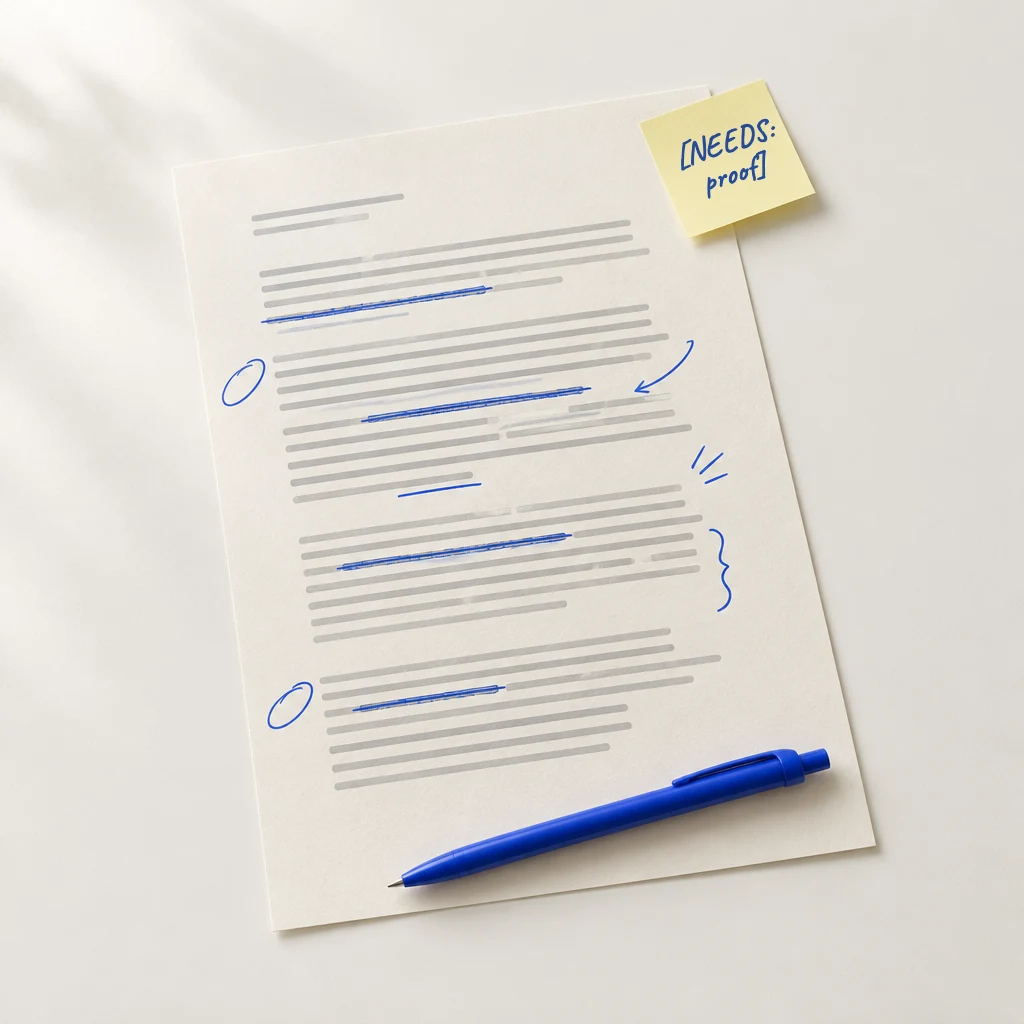
Your AI asks before it writes, picks one angle, writes in your voice and never makes up a quote, a number or an offer.
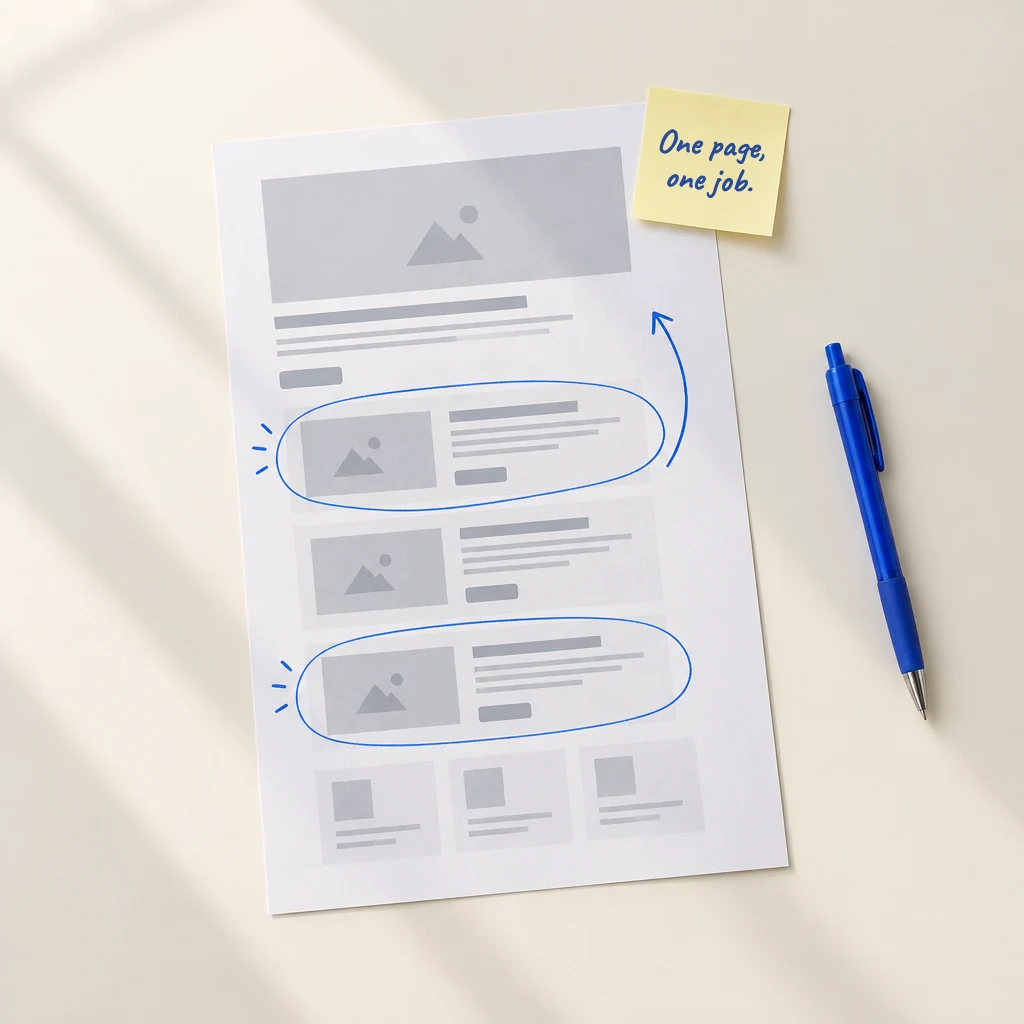
Your AI agrees who the page is for and what it promises, gives every section one job, and hands you a grey, annotated wireframe with every missing fact marked, never made up.
Your AI turns your call notes into a proposal a client can say yes to: their outcome first, one clear idea, the money exactly as you gave it, and never a made-up result.