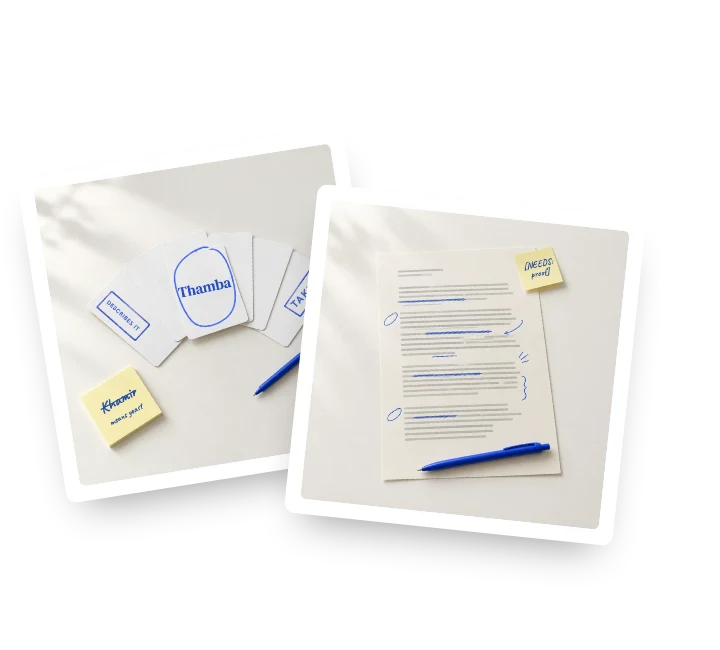
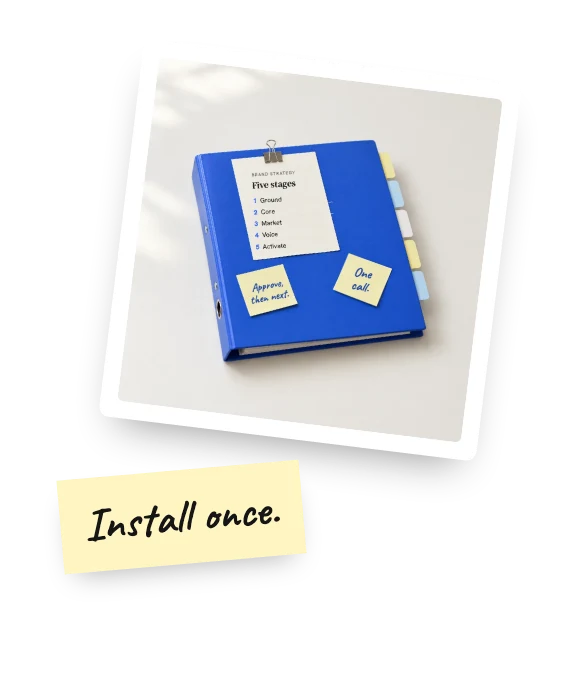
This is one of the three sample outputs that ship in the Copywriting download, published here in full and unedited so you can see what the skill produces before you buy.
Sample: defining a voice from three samples
Sample output, not a customer story. Produced in a pre-release test run on 3 November 2026. The business is fictional and the buyer's answers were scripted. Shown unedited so you can see what the skill produces before you buy.
What the buyer said: "Can you define our brand voice? Here are three things we've written."
The samples (from the fictional bakery, Crumb & Quiet):
- "We bake at 4am so you don't have to. Bread, coffee, and nobody asking how your weekend was."
- "Closed Mondays. The oven needs a day off. So do we."
- "Our sourdough takes 36 hours. Your toast takes 3 minutes. Seems fair."
The voice profile the skill delivered:
How we write: Crumb & Quiet
How to write like us
Like the baker who's been up since four, hands over your loaf, and says one dry thing as you go. That's the whole conversation, and it's enough.
- Casual, never chatty: "so you don't have to", not "we just love helping you start your day".
- Playful on the dry side. The joke is in the understatement ("Seems fair."), never in a pun.
- Reserved. We state the fact and let it do the boasting: "Our sourdough takes 36 hours."
- Plain all the way. We give the number and skip the method; nobody needs "fermentation" explained.
- "We" is the people in the bakery, not a company.
Why those settings: my best guess is that people come to you partly to get away from the noise of a chain, so a voice that talks less fits what they're buying. [HYPOTHESIS] (That tag means: my best guess about your reader, not something a reader told us. We check it before relying on it.)
Words we use
From your three pieces, quoted:
- "bake", "4am", "oven", "sourdough", "bread", "coffee": the work, named plainly.
- "so you don't have to": our effort, your ease, in five words.
- "nobody asking how your weekend was": quiet as part of what you get.
- "Closed Mondays.": rules stated flat, with no apology.
- "needs a day off", "So do we.": the oven and the people get treated alike.
- "takes 36 hours", "takes 3 minutes": the same verb on both sides, so the comparison does the work.
- "Seems fair.": the dry closer.
Drafted by me to fit, for you to keep or strike: "early", "loaf", "the morning bake", "out of the oven", "quiet", "back tomorrow".
Words we never use
- From your answer: bread puns ("you knead this", "on a roll", "loafing around"), cutesy words ("yummy", "nom", "treat yourself"), and chain-marketing phrases ("handcrafted for you", "your daily ritual", "community hub").
- Drafted by me: "artisan", "artisanal", "lovingly", "delicious", "mouth-watering", "indulge", "goodness", "passion", "amazing", "fresh from our family to yours".
- Plus the house list I never write: "elevate", "journey", "curated", "game-changer", "seamless", "unlock" and the rest.
- No praise words for the bread anywhere. None of your three pieces calls it good. They tell you what it takes.
Writing patterns
- Length: very short. Every sentence in your samples runs about two to ten words. A whole piece is two or three sentences.
- Openings: a plain fact about the work or the shop. "We bake at 4am." "Closed Mondays." "Our sourdough takes 36 hours." Never a question and never a greeting.
- Middles: set our side next to yours. "We bake at 4am so you don't have to." "Your toast takes 3 minutes."
- Closes: one short, dry line. A line without a verb is fine, but only one per piece, never two in a row.
- Numbers: in figures ("4am", "36", "3 minutes"), and only real ones. If a time or a count isn't true, it doesn't go in.
- Punctuation: full stops, the odd comma. No exclamation marks, no dashes, no emoji. Your samples use none.
- Contractions: yes ("don't").
- Person: "we" for the bakery, "you" for the customer, in every piece.
- Emphasis: none. No bold, no capitals. The flat delivery is the emphasis.
- Lists: fine when there's a turn in the last item, as in "Bread, coffee, and nobody asking how your weekend was". Never a list of qualities.
- Analogies: from the bakery itself (the oven, the dough, the clock), not from outside.
Context shifts by channel
- Instagram (bio and captions): as above. Two or three sentences, ending dry. No hashtags in the text itself.
- Shop signs: the shortest form. A plain rule, then one dry reason ("The oven needs a day off.").
- Website: one dial moves: a little more patient, so a sentence can run a bit longer to give a fact like opening hours, and the dry close lands once per section, not on every line. Everything else stays.
- Email, ads, product descriptions, packaging: not yet set.
We never
- Joke at the customer's expense. The joke is on us, the oven or the clock.
- Use two verbless lines in a row.
- Praise our own bread. We describe what it takes.
- Make a pun.
- Start with a question or a greeting.
- Use an exclamation mark.
- Invent urgency ("selling fast", "don't miss out") unless it's literally true that day.
- Explain the joke after making it.
What we stand for
Read from your samples. Confirm or strike.
- We believe: good bread takes a long time, and that's fair ("Our sourdough takes 36 hours... Seems fair.").
- We believe: people should get to be quiet ("nobody asking how your weekend was").
- We believe: rest is part of the work ("The oven needs a day off. So do we.").
- We argue against: forced small talk and cheerful service scripts.
- We refuse to say: anything cutesy, any pun, anything that sounds like a chain's marketing (your words).
Three lines in this voice
Written by me, not by you, and checked so a coffee chain or another bakery in town couldn't use them unchanged. They only use facts you gave me.
- Instagram, Tuesday: "Open again. The oven had its day off and was back at work by 4am."
- Website, top of the page: "A small bakery in Bristol. We bake at 4am, and you can come in and say nothing at all."
- Shop sign: "It's quiet in here this morning. That's the idea."
Status: draft, from your three pieces (Instagram bio, door sign, Instagram caption) and your answers today. Covers Instagram, shop signs and the website. I tested it against a coffee chain and against "the other bakeries in town": with a chain's name, all three lines break, because each one rests on something only you've told me: your 4am bake, your Monday closing, the quiet in your name. With another bakery's name, lines 1 and 2 break on the Monday closing and Bristol, and line 3 bends: true for them, but it only makes sense next to the name Crumb & Quiet.
Does this sound like you, or like someone trying to sound like you?
BUYER: Approved.